
The analytical approach and technological background of the EWS NIDAN
NLS (Non-Linear System) systems and the EWS NIDAN's NLEA (Non-Linear Energetic Analysis) approach are based on software comparisons of energetic and informational patterns. The results should be interpreted within the system's own reference database and mathematical assessment model.
In the EWS development approach, a key aspect of moving from NLS towards NLEA is the more detailed subdivision of the frequency ranges examined and the refinement of processing. The aim is to improve the distinction between patterns and provide faster, more consistent software evaluation.
In our development experience, evaluating the longer, broader frequency ranges used in earlier NLS systems together could result in overlaps between different reference patterns. A particular spectral characteristic or similarity coefficient could, on its own, be close to several database entries, leading to less certain classification.
For example, a reference listed in the database as a pathomorphological pattern and a reference assigned to a microorganism could produce similar values. Within the model, this concerns the distinction between reference patterns; such a match does not, by itself, establish a tissue abnormality or the presence of a pathogen.
In the EWS NIDAN's NLEA-based processing, we divide longer frequency ranges into smaller subranges and compare their patterns with the reference data in greater detail.
Evaluating smaller subranges separately can provide additional points of comparison for distinguishing similar reference patterns. Our development aims are to reduce classification uncertainty caused by overlaps, improve processing stability and accelerate the analysis process.
The distinction described here presents EWS's own development approach and is not a general characterisation of all NLS systems. More detailed comparison within the model is not equivalent to demonstrating clinical diagnostic accuracy.
The system uses the headphone-shaped binaural sensor unit, control electronics and KAISHAKU software in a unified workflow. The software compares reference data, performs model-based entropy calculations and displays the results.
The trigger sensor is part of the NLS design's sensing chain. The headphones' infrared wear detection performs a separate function.
In our experience, many Far Eastern NLS copies lack a trigger sensor and instead present infrared components built into the headphones as sensors. Their number is often increased to two, four or eight, but this alone does not mean that the trigger sensor function is present.
In the original design, the infrared transmitter–receiver pair detects whether the headphones are on the user's head. This supports automatic control, allowing the analysis process and bioinductor operation to start and the programme to pause when the headphones are removed.
The infrared transmitter–receiver pair is a wear-detection and control component; it does not replace the trigger sensor.
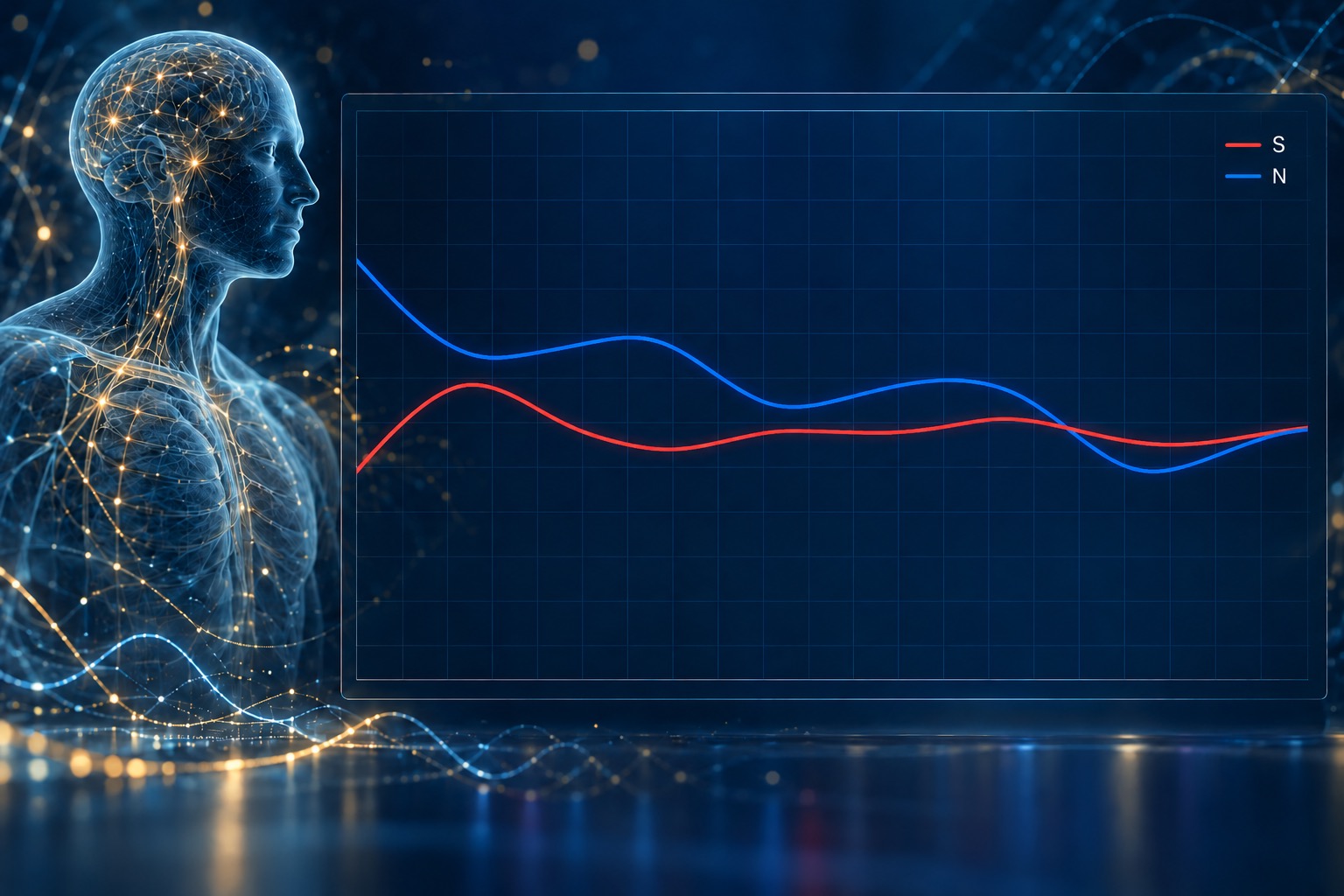
The familiar red and blue comparison curves in NLS software provide a graphical overview of patterns within the system's model. Differences between the curves and calculated coefficients should be interpreted according to the software's own assessment rules.
NLEA-based entropy values are also part of the system's mathematical model. They are not directly measured, clinically validated physiological indicators.
The NIDAN functions called vegeto-test, metatherapy and informational harmonisation supplement the reference comparisons and programmes associated with the energetic model. They are not established medical diagnostic or therapeutic procedures; we do not base claims about detecting or destroying microorganisms on them.
The EWS NIDAN is not a medical diagnostic device. The clinical diagnostic validity of the NLEA energetic and informational assessment model has not been established. The system's results cannot be used to diagnose or rule out diseases or infections and do not replace medical examination, diagnosis or treatment.